When the mission is ready but the organization isn't
You’ve found a grant. It might be THE grant. It fits your work almost perfectly, the deadline is doable, and the funding would cover a gap that has been nagging at you for a while. Although your mission is strong, and the need in your community is obvious, getting the grant out the door… It's a struggle.
You’re hunting for board rosters, financial statements, and outcome numbers but everything is woefully out of date (if it exists at all).
You’re right to want to apply. You see a match between what a funder wants to support and what your organization actually does. Most strong grant programs start exactly there.
Grant readiness isn’t about your mission or the case you can make about community impact. It’s about being prepared to showcase how your organization is built and run. Let’s explore grant readiness through the funder’s eyes.
What grant readiness means to a funder
Many grant programs start like this: a board member mentions offhandedly that the organization should go after grants without a clear sense of what pursuing them involves. From there, readiness gets defined internally by what leaders feel and see: a mission people believe in, a need in the community, a case for support.
Funders are looking at a different set of questions. Before an award, most conduct some form of pre-award due diligence to decide whether your organization can carry out the work, safeguard the money, and report on it accurately. That review reaches into financial systems, governance, staffing, filings, and your history of tracking outcomes rather than just describing activities.
The mission attracts a funder's attention, but organizational systems are what support the funding decision.
Remember what a grant obligates you to do
Grants arrive with conditions attached. Most awards are restricted funds, which means you can spend the money only on the approved purpose. You have to track and report on it separately from general operating dollars (similar to donor-restricted income).
Many grantmakers require both financial reporting on how the money was spent and impact reporting on what it accomplished, often on a fixed schedule set in the agreement. Producing those reports takes capacity: someone tracking expenses, documenting outcomes, and financial systems that can show the funder(s) exactly where their money went.
The consequences of falling behind are concrete. Late or incomplete reports can lead to withheld payments, a suspended or terminated award, and lost eligibility for future funding. Strong financial systems are what lets you keep the grant and win the next one.
Tax filings signal grant readiness (or not)
One legible marker of where an organization stands is which version of the IRS Form 990 it files. New and small organizations file the 990-N, an electronic postcard that reports minimal information. Once revenue grows, the organization moves to the full Form 990, a far more comprehensive report.
The full 990 breaks down expenses across program, management, and fundraising, reports compensation for officers and highly paid staff and contractors, describes what the three largest programs accomplished during the year, and documents governance practices like how the board reviews the return itself. That is close to the same picture a funder builds during due diligence.
Although plenty of smaller organizations win funding while still filing a 990-N, an organization filing a full 990 has usually already built the accounting systems, expense tracking, and board oversight that grant reporting depends on.

A glimpse into what funders are looking for
Most of the readiness markers funders check trace back to a single question: can this organization absorb a grant and deliver on it without falling apart?
Here are a few things they’re assessing:
Mission drift: has your mission held steady for a while, or does it look like you’re chasing a funding trend?
Revenue mix: A base of individual donors tells a funder the community already backs the work, and that unrestricted giving can absorb fluctuations when a grant ends. This is why many organizations start with individual donors and add grants later.
Programmatic outcomes: funders expect measurable results, and organizations without a tracked history of what they accomplished are at a disadvantage. Some funders ask for baseline data and progress against it.
Board size and governance maturity: funders routinely review board composition, meeting regularity, and conflict-of-interest policies as signals that someone beyond the ED is watching the money. Although there’s no ideal board size, effectiveness research indicates you want a larger, active board.
Financial history: some funders (e.g., Bayer Fund) require two years as a 501(c)(3) and recently audited financials. A qualified audit opinion can disqualify an applicant outright. Two clean years without recent deficits is a great start.
This doesn’t mean grants are closed to you until you check all the boxes. The markers above describe what large, multiyear institutional funding tends to require.
Smaller awards from community foundations and emerging-organization programs ask far less of your operations, and in the Pacific Northwest we have watched a growing number of funders intentionally reduce eligibility requirements to open doors for newer and smaller organizations.
The real question is scale: when you talk about raising a third of your organizational budget with grants, you need to have the operations in order.
Counting the cost before you commit the hours
Every application takes staff hours before the money even arrives, and those hours come out of program delivery, donor relationships, or the systems work that would make the next application easier.
Chasing grants your nonprofit isn’t positioned to win, or can’t manage once awarded, means capacity gets spent without return. Sparse administrative infrastructure sinks more grant efforts than weak writing does.
Knowing where you stand before you apply is what turns grant work from a scramble into a plan.
Turning the question into a working checklist
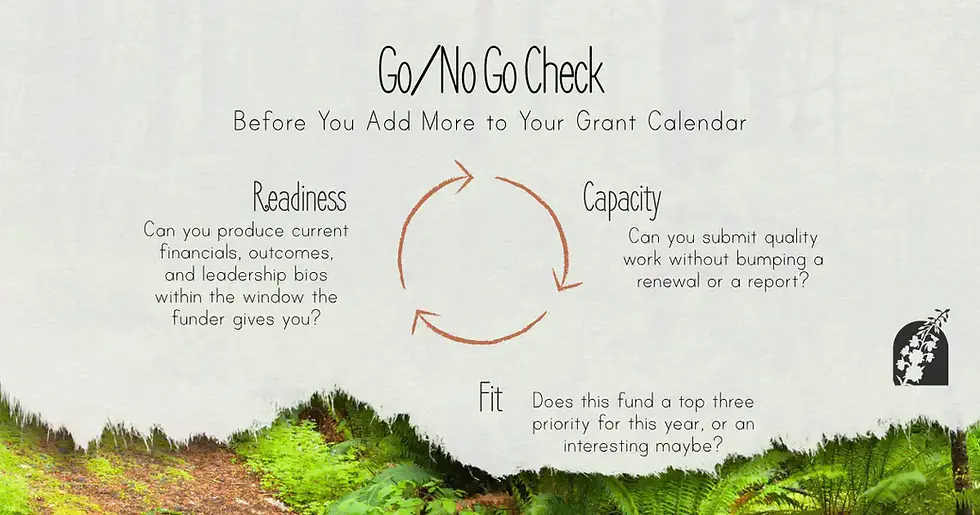
Before your next application, ask yourself: does your organization already have the structure a funder expects to see, or are there gaps you need to close?
Our free interactive Grant Readiness Checklist walks you through the markers a funder weighs during due diligence, from filing history and financial track record to governance and outcome tracking. It gives you clarity on where you stand and which pieces to strengthen before you invest hours in a proposal.
If the checklist turns up gaps, closing them is what ourBlossom Bundle was built for: a focused three-month engagement that puts the foundations in place before you start applying.