top of page
how to manage your fall grant calendar
Learn how to keep your grant calendar manageable.

By late summer, most organizations have already built their fall grant calendar in hand. Earlier this summer, we walked through what belongs on a realistic fall grant calendar: reports first, renewals next, capacity protected, and only then  new applications slotted into what remains.


Then September arrives…. The gala takes over everyone’s attention. . The board retreat needs a deck, a funder moves a deadline. Program staff are trying to launch fall programming, and the person managing the grants is the same person managing everything else. The calendar that looked reasonable in July starts slipping, one skipped touchpoint at a time.


Building the calendar is the easy part. Managing your fall grant calendar consistently is what determines whether you hit your fundraising goals. If you walked through our guide on creating a realistic calendar, now’s the time to develop your weekly rhythm: how many hours you can devote to your plan, and the small routines that keep a fall plan working no matter how busy you get.


Manage Your Fall Grant Calendar: Start with Capacity, Not Deadlines 

A calendar full of due dates assumes you have the hours to meet the deadlines. As yourself one question: Do we actually have the capacity to complete everything on this calendar? 


Here's a useful point of reference: when we run a grant program alongside a client, the client's side of the work comes to about one to three hours a week. Cultivation touches take around 15 minutes each, and there are usually three to five in a month. Proposal reviews run anywhere from 10 minutes to a full hour depending on complexity. Add a standing check-in, and that's your workload, with our team carrying the research, drafting, and tracking underneath it.


If you're managing grants in-house, those one to three hours quickly become five, ten, or more. . The drafting, the prospect research, the tracker upkeep, and the follow-up. Count those hours the way you'd count a deadline and block them on the calendar. It takes discipline to hold yourself to those time blocks. Resist the urge to give those blocks away to competing priorities.


Schedule Cultivation Like You Schedule Deadlines 

Successful grants management means you not only have deadlines for writing, but you also need to block out time for relationship building. Cultivation gets dates and owners, the same as proposals:

  • A weekly 30-minute block to queue outreach: a thank-you note, a program update, a question that invites a reply

  • A monthly share-out from program staff with one story, one metric, and a photo you have permission to send

  • Templates and talking points in a shared folder, so a touchpoint doesn't stall when its owner is out

Make cultivation non-negotiable. 


Hold a 15-minute Weekly Standup

One short meeting prevents hours of scrambling later. Same time each week, three questions:

  • What's due in the next two weeks?

  • What's blocked, and who can unblock it?

  • What can move if something changes?


Name a lead and a secondary for every proposal and report, so the answer to “who has this” never depends on one person's inbox. Small routines beat heroic pushes, and a 15-minute standup in September prevents a very long night in November. 


If you’re a team of one, use the 15 minutes to check in with yourself and ask the same questions.


Keep One Grant Tracker, and Keep It Current

What we’ve seen among organizations that manage their own grants is the funder list is long, and the system around it can be thin. 


We suggest one centralized grant tracker. Keep it simple. Create a spreadsheet with a few columns: due date, task type, owner, status, next touchpoint (you can also use Notion or Airtable). Pair it with a funder folder that holds your standard attachments, boilerplate language, and past submissions, so nobody rebuilds an application packet from scratch in a deadline week.


Put report prep dates on the tracker at least a week ahead of the due date (not on the due date itself, give yourself time). Reporting stays steady when the prep is scheduled, and a late report can cost you more with a funder than a missed prospect.


Oh, and key dates should also be on your work calendar, especially if using a grant tracker is new.
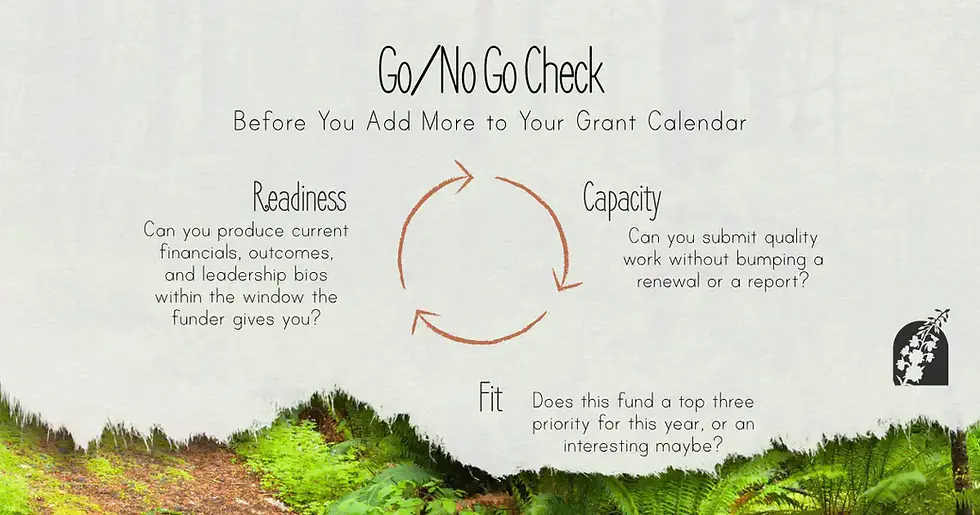

Go/No Go Checklist before you add to your grant calendar
Readiness, capacity, and fit are important factors to consider before adjusting your grant calendar.

Before You Chase Another Grant… 

Every fall, a new opportunity pops up that feels too good to pass up. Before you rearrange your calendar, ask three questions. 

  • Readiness: can you produce current financials, outcomes, and leadership bios within the window the funder gives you?

  • Fit: does this fund a top three priority for this year, or an interesting maybe?

  • Capacity: can you submit quality work without bumping a renewal or a report?


If any answer is no, the opportunity isn't lost. Log it for winter prospecting and put a cultivation note on the calendar for the next cycle. Renewals are almost always your strongest funding opportunity. Don't jeopardize them for a long-shot application.


Schedule the Follow-Up, Too 

Much of what you submit this fall will fund next year's work, and funders will sometimes ask for budget figures that don't exist yet. A funder who knows you will take current numbers now and updated figures later, but only if the follow-up happens.


Be sure to make a follow-up tracker task with a date and an owner, not a mental note. The same goes for the conversations that feel harder than the writing: the check-in after a submission, the question about timing, the update when your numbers change. Those conversations deserve calendar time just as much as proposal deadlines.


The difference between a plan and a program

Anyone can build a grant calendar. The organizations that consistently meet their fundraising goals are the ones that follow it. You don't need a perfect system. You need one you can realistically maintain every week through the busiest months of the year.


If keeping your grant calendar current feels impossible while you're balancing everything else, that's exactly what our Perennial Partnership is designed for. We manage the grant calendar, track deadlines, support cultivation, and keep the work moving so your team can stay focused on the mission.


fall grant calendar nonprofits
Fall Grant Calendar for Nonprofits: 5 Most Important Items to Include

As the summer months progress, many nonprofit leaders sit down to map out fall grants. The process usually results in a long list of funders, a handful of hard deadlines, and the hope that there’s enough time to get to all of it. 


The list may feel like progress. It may even look like a plan. But…. a list isn’t a plan, and a calendar isn’t a strategy. 


The organizations who move through fall with the least panic aren’t the ones chasing the most grants. They’re the ones who built a prioritized calendar, including protecting the time to run it. If you spend the summer thoughtfully building toward a calmer fall season, this is where that planning pays off.


So, before you start filling in submission deadlines, let’s take a step back and ask what belongs on a fall calendar in the first place. 


Here’s how we work through it with clients.


1. Start with what’s already owed

Reporting deadlines come first, before any new opportunity. A late report is one of the fastest ways to damage a funder relationship you already worked hard to earn.


Pull every reporting obligation for grants you currently hold and put those due dates on the calendar before anything else. They’re non-negotiable, they’re already committed, and they protect the funding you have. I get it. New money is exciting. … but keeping the money you’ve already been trusted with matters more.


2. Lock in renewals next

If you receive grants that renew early in your fiscal year, fall is usually when those renewals come due. Map it out now. These are your highest-probability dollars, because the relationship and the track record already exist, and they’re the easiest to lose simply by missing a window.


Renewals rarely feel urgent the way a new opportunity does, which is exactly why they can fall off your schedule. Treat them with the same seriousness as a first-time application.


3. Protect the time the work actually takes

A grant calendar that only tracks deadlines assumes the people doing the work have unlimited hours. They don’t.


Fall is gala season. It’s board retreat season. For a lot of small and mid-sized organizations, the same person writing the grants is also running the event, prepping the board deck, and answering everything else that comes up. 


When we project time for a client, we plan for at least 15 minutes on every cultivation task, and there are usually three to five of those a month, plus proposal reviews that can run anywhere from a quick fifteen minutes to a full hour for a collaborative task. It all adds up. A realistic calendar accounts for the time it takes to do the work.


Look at where your fall events fall, then build your grant deadlines around the weeks your ED or development director will actually be available. 


A deadline you can’t staff isn’t a deadline you’ll meet.


4. Prioritize hard deadlines, then evaluate what to slot in

Once you document reports, renewals, and your realistic capacity, you can see what’s left for new applications. Start with the grants that have fixed deadlines, since those are the ones you lose by waiting. Some of these will start with a letter of intent before the full proposal, so build that earlier step into the timeline too.


Then look at rolling opportunities and grants without a hard cutoff. Many corporate funders and bank and CSR programs fall here, with flexible giving cycles. They often take more digging to find on funders’ own websites, but they’re the grants you can move into the gaps, the weeks when the event is over and there’s room to write.


This is also the moment to check in about volume. If grant writing isn’t someone’s full-time job, applying for seven or eight fall grants sets you up for disappointment. We’d rather see a client submit four strong applications than eight rushed ones. Your calendar should reflect what’s realistic, not what’s aspirational.


5. Plan for the budget gap before it surprises you

Know your numbers so you’re not caught off-guard. A lot of what you apply for this fall won’t arrive until well into next year


This is why relationship building is so important. 


A funder who knows you will accept a proposal with current numbers and a note: ‘here’s what I have today, and I’ll send updated figures the moment they’re ready.’ That kind of communication only works if the relationship is already there, which is why you can’t hold off on the relationship until the application is due.


The calendar only works if someone manages it

You can have the cleanest calendar in the world… BUT, it does nothing if it sits in a drawer collecting dust. Grant work is about half relationship-building and half writing the application. The writing has a clear deadline on the calendar. Relationship-building is the part that can get overlooked when things get busy, even though it’s just as important in determining whether the application has a real chance. 


Unfortunately, we’ve seen it happen. A client receives a cultivation task, doesn’t act on it, and reaches out months later. The funder responds right away and asks for a meeting. The client doesn’t respond. By the time they circle back, the funder has lost confidence, not because the work wasn’t strong, but because the follow-through wasn’t there. 


Skipping cultivation doesn’t just delay a grant. It can reduce the likelihood of receiving one at all.


A well-managed fall calendar protects you against that. It puts the cultivation touches on the page alongside the application deadlines, so the relationship work has a place and a time instead of landing on the ‘someday list.’


Build the calendar you’ll actually use

A realistic fall grant calendar is shorter than the laundry list of tasks most organizations create. Be sure to include the essentials:

  • Reports

  • Renewals

  • Relationships

  • Project/work time

  • Deadlines

Then, you can slot in rolling grant applications. And finally, don’t forget to handle budget conversations through relationships and followups (rather than delaying proposals).


Don’t have time to do this? Contact us to learn how we can expand your capacity.

Bloom Grant Consulting Window Logo

Bloom Grant Consulting Helping nonprofits harness their grant potential. 

  • LinkedIn
  • imgbin-email-computer-icons-logo-email-61tT8WZwjzSaJiZAqgL8S9Gbi_edited

Get Grant Advice in Your Inbox

© 2026 by Jacquelyn Kurdas LLC.

bottom of page